
Resources
What Is No-Touch Sanitizing, and When Does Your Facility Need It?
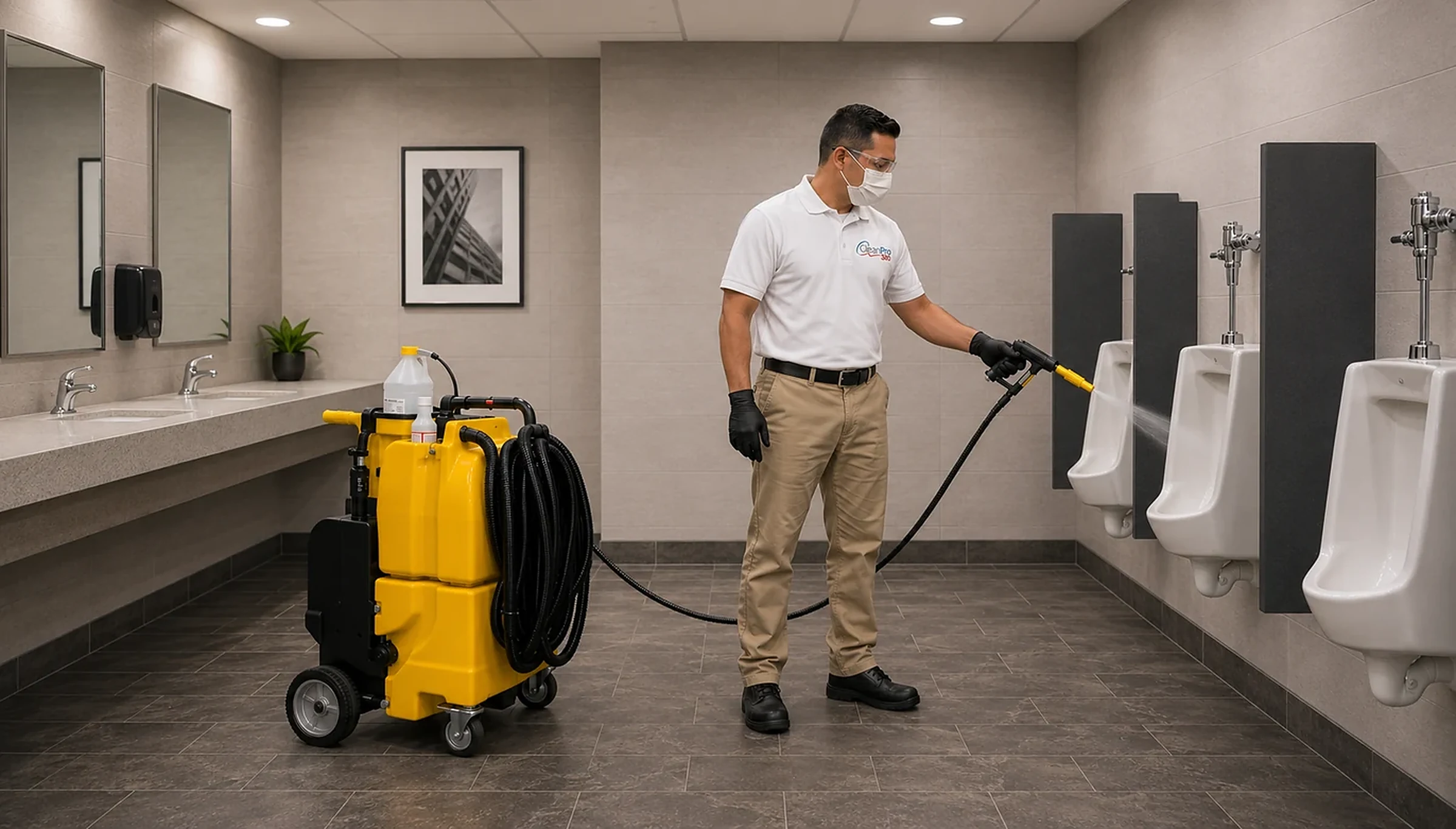
Mopping is the right tool for a lot of floors. It is a poor tool for a restroom that stays busy, a locker room, or a bar floor after a weekend. The mop gets dirty, and from that point it moves soil as much as it removes it. No‑touch sanitizing is the process we use when a hard‑surface room needs more than that.
Facility managers in Taylor, Hutto, and Round Rock usually call when a restroom smells clean for an hour and then does not, or when grout stays dark no matter how often it is mopped. This page explains what the service actually is, and when it belongs on your schedule.
What the process is
No‑touch sanitizing is a touchless spray‑and‑extract clean for hard surfaces. It is not a fogger, and it is not a wipe‑down with a stronger bottle. Our no‑touch sanitizing visits follow five steps.
- Apply. Cleaning solution is sprayed onto floors, walls, and fixtures so soil can loosen. The application is touchless, which keeps a dirty cloth from being the thing that travels from one fixture to the next.
- Agitate. Heavily soiled spots, usually grout lines, corners, and the floor around toilets or urinals, are agitated so the soil actually breaks free.
- Rinse. Fresh water carries the loosened soil off the surface.
- Extract. A vacuum recovery system pulls the water, soil, and residue back out. The soil leaves the room. It is not pushed into the next corner.
- Leave it ready. Surfaces are left clean and nearly dry, so the room can go back into use without a long wait.
The service page describes the result as clean, sanitized hard surfaces. What we can describe is the mechanical part: the process removes soil that a mop leaves behind, and it limits how much of that soil is carried from one surface to another on the tool itself.
Where it earns a place on the schedule
We use it in restrooms, locker rooms, showers, commercial kitchens and bars, fitness facilities, and other hard‑surface rooms that take heavy soil. A few patterns tell us the routine clean is no longer enough.
- The restroom is cleaned on schedule and still smells by midday.
- Grout is visibly darker than the tile, and mopping has not changed it.
- The room is wet, salty, or greasy by design: showers, kitchen floors, a bar after service.
- You have had to close a restroom for a deep clean because the weekly work could not catch up.
- A mop is the only tool currently used, and the same bucket serves the whole room.
It can be part of a routine program, a periodic visit every few weeks, or a one‑time reset. Clinics sometimes add it for staff and public restrooms. That is separate from the disinfection schedule inside exam rooms, which we cover in how often a medical office should be disinfected. No‑touch work does not replace the product and contact‑time rules your clinical rooms already follow.
How often, as a guideline
There is no single frequency. These are starting points we adjust after we see the room and how it is used.
- Very high soil. Busy restaurant or bar restrooms, and kitchens that run every day. Weekly is a common request. Some bars want the floor done after the weekend and not again until the next one.
- High soil. Fitness locker rooms, school restrooms, and large office restrooms. Every other week or monthly often holds if the nightly crew is already cleaning them well.
- Moderate. A smaller office or a church hall restroom. A monthly or quarterly reset is often enough, with routine cleaning in between.
- Reset. A room that has gotten away from you, before an event or after a renovation. One visit, then a decision about whether it joins the recurring plan.
If the nightly clean is inconsistent, adding no‑touch on top of it will disappoint you. The spray‑and‑extract visit removes the built‑up soil. The routine visits are what keep it from returning at the same speed.
What it does not do
It is a cleaning process for hard surfaces in commercial buildings. It is not a substitute for handwashing, for your own sick policy, or for a disinfectant step your industry requires on a specific surface. It does not clean carpet, upholstery, or ceilings. It does not repair failing grout or fixtures. If the grout is cracked or the floor drain is slow, we will say so, because extraction cannot fix either one.
We also do not treat every room in a building this way. Private offices, open carpeted areas, and most lobbies are better served by routine facility cleaning and, when the floors need it, periodic floor care. Putting a recovery machine in a carpeted conference room is the wrong tool.
Why the climate here makes restrooms work harder
Central Texas heat runs for a long season. Fitness centers, school gyms, and apartment amenity showers stay damp, and a damp grout line holds odor. In Round Rock, Austin, and Cedar Park, lunch‑rush restrooms in office buildings take a spike of traffic and then sit. In Georgetown, Hutto, Pflugerville, Leander, Liberty Hill, and Taylor, we see the same rooms at a smaller scale, often with more dust tracked in from parking lots and caliche. That dust turns into mud the week it rains, and the mud ends up on restroom floors because that is where people walk next.
Pollen season adds another film. It is not the main reason to book this service, but a restroom that is already borderline will look worse in February, when cedar pollen is on every door pull, and again in spring.
How to decide
Walk the worst restroom at the end of a busy day, not at opening. Look at grout, the floor behind toilets, and the corners. If a mop is keeping it acceptable, you may not need this service yet. If the room is clean on paper and still not acceptable, a spray‑and‑extract visit will show you the difference in one appointment. We can then tell you whether it belongs on a rotation.
Request a free on‑site quote or call us at (512) 200‑7093. We serve facilities across Williamson and Travis Counties, and we would rather see the room than guess at a frequency from a square‑foot number.
Frequently asked questions
What is no-touch sanitizing?
It is a touchless spray-and-extract clean for hard surfaces. Solution is sprayed on floors, walls, and fixtures, heavily soiled areas are agitated, the surface is rinsed, and a vacuum system pulls the water and soil back out. The room is left nearly dry.
When does a facility need no-touch sanitizing?
When routine mopping is not keeping a high-soil room acceptable. Typical rooms are restrooms, locker rooms, showers, and commercial kitchen or bar floors. Carpeted offices are not the right use for it.
How often should no-touch sanitizing be scheduled?
It depends on the room. Very busy restrooms are often done weekly. Many fitness and office restrooms fall on an every-other-week or monthly cycle, and lighter rooms may only need a periodic reset. Routine cleaning still has to happen in between.